Seeds of Sovereignty and stewardship
What is Seed Sovereignty?
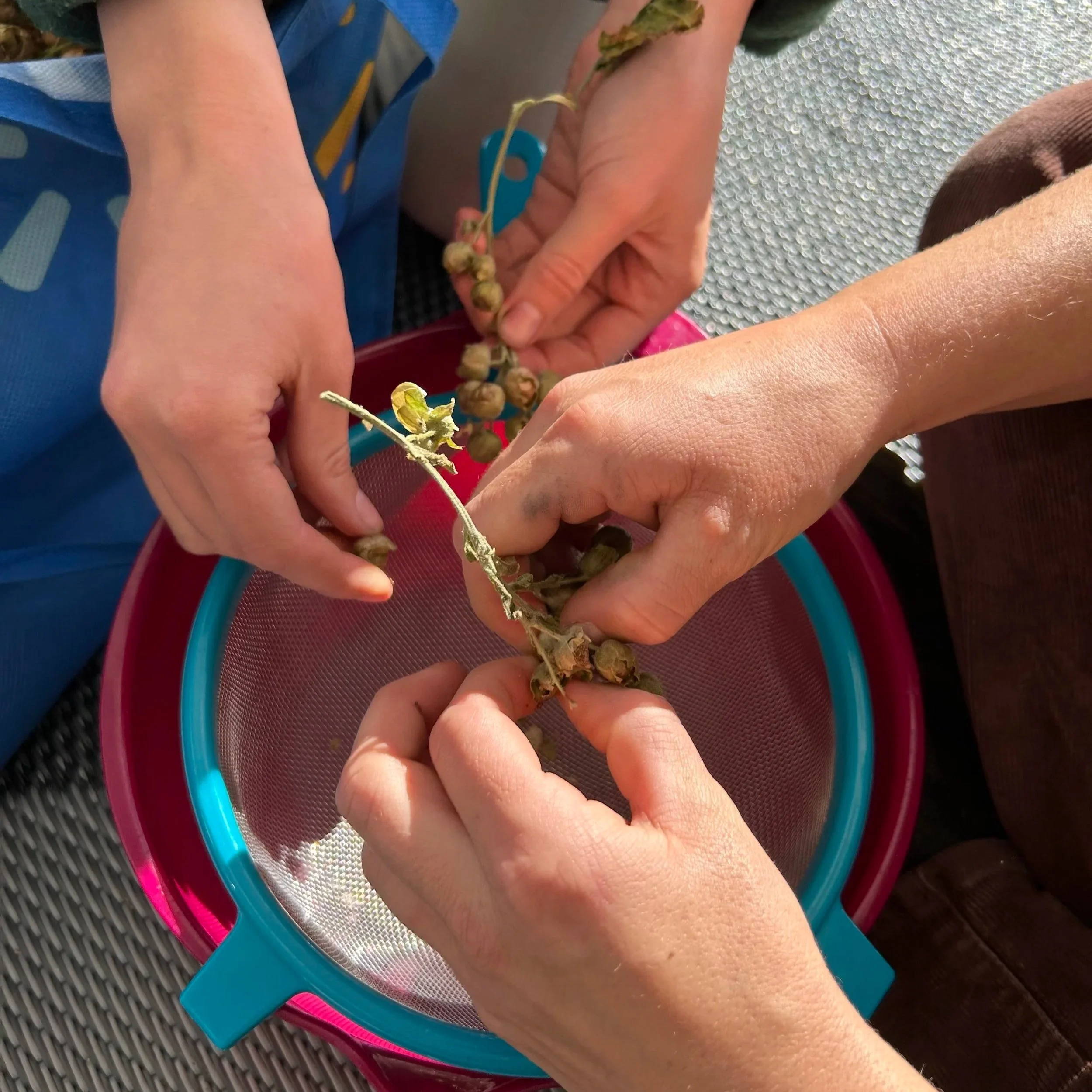
Image: Saving tobacco seeds harvested from the Food Commons.
Seed sovereignty is the right to save, grow, exchange seeds without dependence on large corporations or restrictive laws. For many Indigenous peoples, seeds are carriers of ancestral knowledge and ecological stewardship practices developed over generations. Colonization disrupted these relationships through land dispossession, forced assimilation, and the introduction of industrial agriculture and patented seeds. Seed sovereignty restores community authority over traditional seed varieties, protects biodiversity, and supports the transmission of cultural knowledge to future generations.
Why is seed Sovereignty important?
Communities are better able to grow culturally significant foods, adapt crops to local climates, and respond to environmental change
Seed sovereignty safeguards biodiversity at a time when industrial agriculture has narrowed the global seed base.
Seed sovereignty is an act of cultural renewal and resistance: it affirms Indigenous rights and connects people to land and tradition.
What is Seed Stewardship?
A seed library is a living collection that depends on people saving and sharing seeds year after year. Every time a seed is grown out, selected, and saved locally, it becomes a little more suited to Revelstoke: hardier, better timed to our frost dates, more resilient to whatever the season throws at it. This is how seed adaptation has always worked. Not in a lab, but in thousands of backyard gardens, generation after generation, each one leaving a seed a little better matched to the place it grew.
Stewarding seed also means protecting something bigger than any one garden. As commercial seed production becomes more consolidated and fewer companies control more of the world's seed supply, genetic diversity narrows, too. Fewer varieties, bred for shipping and shelf life rather than flavour or resilience. Community seed libraries are one of the ways people push back: keeping many varieties in circulation, keeping control of the food system in local hands, and choosing what gets grown, how it's adapted, and who it's passed on to. Every packet returned to the library is a small act of keeping that choice alive.
Become a Seed Steward: Participate in the Revelstoke Seed Library!
Revelstoke Seed Library
How It Works
The LFI Seed Library is hosted by the Okanagan Regional Library at 605 Campbell Avenue. It's free to use for LFI members, or by donation for non-members.
Browse the seed collection during library hours.
Take what you need for the season. Envelopes are provided on-site.
Grow your seeds at home, in a community garden plot, or even in a few containers on a balcony.
Save seed from your healthiest plants at the end of the season, if you're able.
Return a portion of what you harvest to keep the library stocked for next year.
You don't have to return anything to use the library, but the Revelstoke’s seed sovereignty and the Library’s seed collection grows stronger every time someone does.
Participate in the Library
Local seeds grown with love are the only requirement. Donate packets of herb, flower, legume, fruit, or vegetable seeds any time by dropping them off at the library. Seeds that have adapted to our growing conditions (our short seasons, our soil, our climate) are more valuable to the next grower than anything shipped in from elsewhere. Keep it local!
Seed Saving: The Basics
Seed saving can be a fun hobby, a revolutionary act, or a career. Seeds you save yourself have a special advantage: they're already learning to thrive right here in Revelstoke, adapting to our seasons, soil, sunlight, wind, and water with every generation you grow.
Open-Pollinated vs. Hybrid vs. GMO
Not all seeds are created equal when it comes to saving. Open-pollinated varieties are pollinated naturally (by wind, insects, or self-pollination) and will grow "true to type", meaning the seeds you save will produce plants just like their parents. Hybrid (F1) varieties are bred by crossing two different parent plants; they're often bred for specific traits like disease resistance or uniform size, but their seeds are unpredictable and usually won't grow true. Heirloom varieties are open-pollinated varieties that have been passed down for generations, often with a story attached. Our Seed Library focuses on open-pollinated and heirloom seeds, since these are the ones worth saving and sharing.
Annuals, Biennials, and Perennials
Annuals (like beans, peas, lettuce, and tomatoes) complete their life cycle in one season, making them the easiest place to start your seed saving journey. Biennials (like carrots, beets, and kale) need two full seasons. Biennial seed saving takes patience, and, in our climate, sometimes some extra protection to get plants through winter. Perennials come back on their own year after year, and some (like some herbs) can be propagated by seed, division, or cuttings.
Self-Pollinating vs. Cross-Pollinating
Self-pollinating plants (beans, peas, lettuce, tomatoes) fertilize themselves, so there's little risk of unwanted crossing, even if you're growing a few varieties close together, your saved seed will usually stay true. Cross-pollinating plants (squash, corn, brassicas like kale and broccoli) rely on wind or insects to move pollen between plants, including between different varieties of the same species. If you're growing more than one variety of a cross-pollinator, they may cross with each other, and the seed you save could be an unpredictable mix. This is why beginners are often encouraged to start with self-pollinators before working up to the more advanced techniques (isolation distances, hand-pollination) that cross-pollinators require.
Why This Matters for Adaptation
Every time you save seed from your best-performing plants, you're nudging that variety toward being a little better suited to Revelstoke's growing conditions. Seeds saved and grown out over many seasons in one place develops what's sometimes called "landrace" resilience; not through breeding in a lab, but simply through the plants that survive and thrive here being the ones that get to pass on their seed.

